
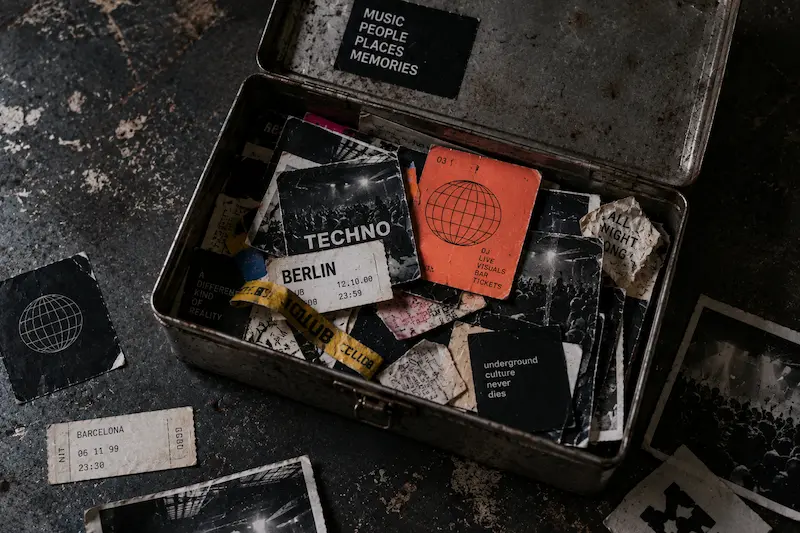
Before the algorithm, you had to find the culture.
There is something about all this that reminds me of The Neverending Story.
Bastian Balthazar Bux hiding in his school attic, opening a book without knowing that, little by little, he would become part of the story he was reading.
Opening this box almost thirty years later gives me a strangely similar feeling.
I know some of the things inside. Others I have forgotten.
I pull out a flyer and a name appears.
Another one, and there is an address.
A date. A club. A night.
And little by little, something that seemed to belong to a distant past begins to reconstruct a story I was part of too.
Inside are hundreds of flyers, passes, concert tickets, credentials, posters and other pieces of paper I started keeping, mostly from the late nineties onwards.
I never thought I was building a collection.
Much less an archive.
I was simply going places.
Some of those pieces of paper ended up in a pocket, came home with me and, for whatever reason, never made it into the bin.
Almost thirty years later, they are still here.
WE DIDN’T KNOW WE WERE BUILDING AN ARCHIVE.
WE WERE JUST GOING OUT.
BEFORE THE FEED
Before an algorithm decided what to show you, discovering music, a party, a club or a scene worked differently.
Culture circulated physically.
Through friends. Record shops. Magazines and fanzines. Clubs. Concerts. Tapes and records. Posters on the street.
And flyers.
A flyer could simply be an advert for the following Friday.
But it could also contain a name you had never heard before, an address you had never been to, or music you didn’t yet know you were going to care about.
You picked it up.
Folded it.
Put it in your pocket.
And maybe a few days later, you showed up.
There was more friction between discovering something and getting there.
You had to ask.
You had to move.
You had to look for it.
And sometimes, you literally had to find it.
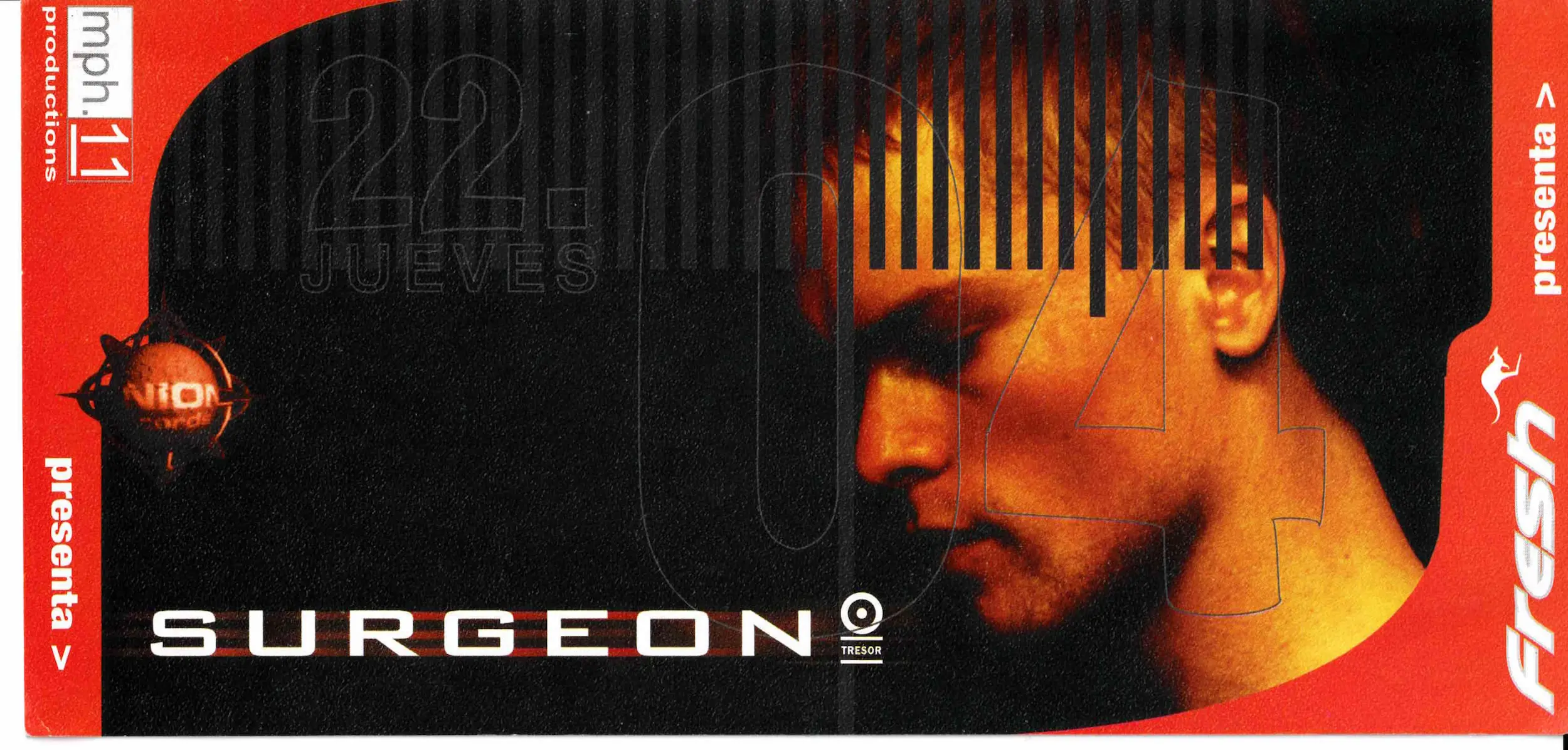
SURGEON Original flyer · Everybody Loves Archive
MADRID
In the late nineties and early 2000s, a night in Madrid could take you through completely different places.
Large parties at the Círculo de Bellas Artes.
Clubs like Soma or Cocoon.
Venues like Arena.
Parties in squatted buildings.
Raves on the outskirts of the city.
Places you knew about because someone had handed you a piece of paper, because a friend knew where to go, or simply because someone knew someone.
We moved between all of this without thinking too much about whether we were part of a scene.
It was simply what was happening.
And the flyer was one of the things connecting those worlds.
THE FLOOR AT THE CÍRCULO
Some memories lose their edges after almost thirty years.
One of mine is a night at the Círculo de Bellas Artes.
I remember Detroit techno.
I remember Derrick May.
In my memory, names like Jeff Mills and Juan Atkins appear too, although after all these years it is entirely possible that different nights have blurred into one.
But there is one thing I remember much more clearly than the names.
The floor vibrating.
When I started reconstructing that period, a date appeared:
6 March 1999.
Especial Detroit.
Círculo de Bellas Artes.
Static Sound System.
And Derrick May was there.
Suddenly, a memory that had been floating around for decades had a date and a place again.
But not everything fitted perfectly.
And perhaps it doesn’t have to.
Because one of the first things you discover when you open a box after almost thirty years is that memory is imperfect.
The archive is too.
This project exists somewhere between the two.

STATIC SOUND SYSTEM — LA NOCHE MÁS LARGA
Madrid, 1998 · Original flyer · Everybody Loves Archive
This surviving Static Sound System flyer is from the same period, but not from the March 1999 Especial Detroit night.
SOMA
For a while, Soma was almost a weekly ritual.
It was at Leganitos 25, in the centre of Madrid, and we went there practically every weekend.
After a while, the people working there knew us. Flyers were picked up inside the club itself, and sometimes they would give us posters too.
None of it felt like collecting.
You took a flyer because it told you what was coming next. A poster because someone gave it to you. A pass because you had used it to get through the door.
Then there was the club itself.
I remember the heat.
The crowd.
And the condensation.
The walls and even the ceiling literally sweated.
It is one of those details that sounds exaggerated until you have been inside a club packed tightly enough for the building itself to seem alive.
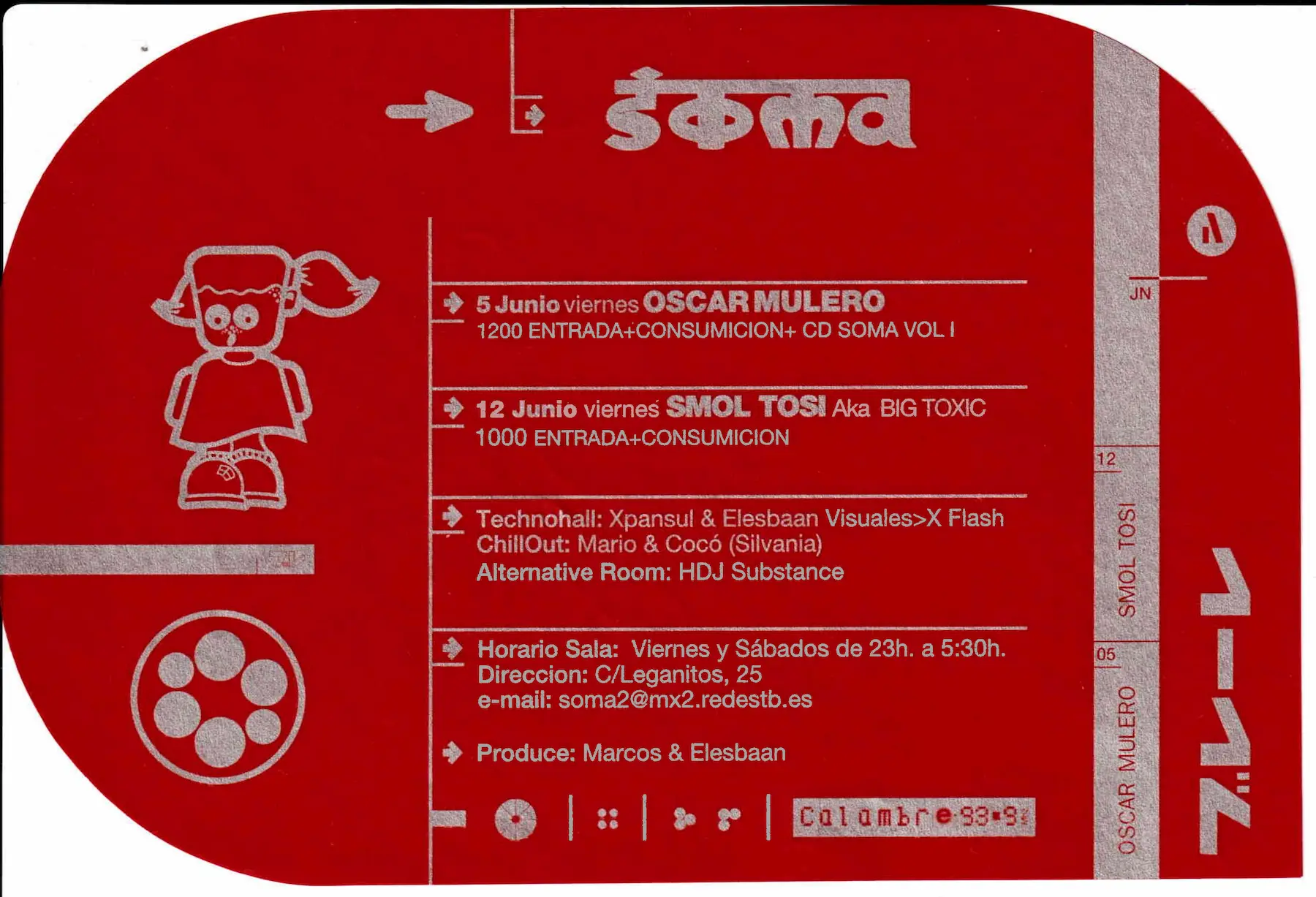
SOMA EXPERIMENTAL CLUB
Leganitos 25, Madrid · Original flyer · Everybody Loves Archive
WATCH / SOMA EXPERIMENTAL CLUB
Mini-documentary published for Soma’s 2013 anniversary, including photographs of the original club interior.
A CLUB, AND SOMETHING MORE
Soma was a physical place, but it was also something more.
The name travelled beyond Leganitos 25.
Soma presented events elsewhere in Madrid, connecting the club to larger venues, international artists and a wider network around electronic music.
One of the flyers that survived in the box makes that especially clear.
Richie Hawtin.
Plastikman.
Decks, EFX & 909.
Oscar Mulero. Elesbaan.
And, printed on the flyer:
Soma Experimental Club presents at Sala Arena.
A piece of paper that once told you where to go on a Thursday night now shows something else:
Soma was not only a room. It was part of the infrastructure through which the culture moved.
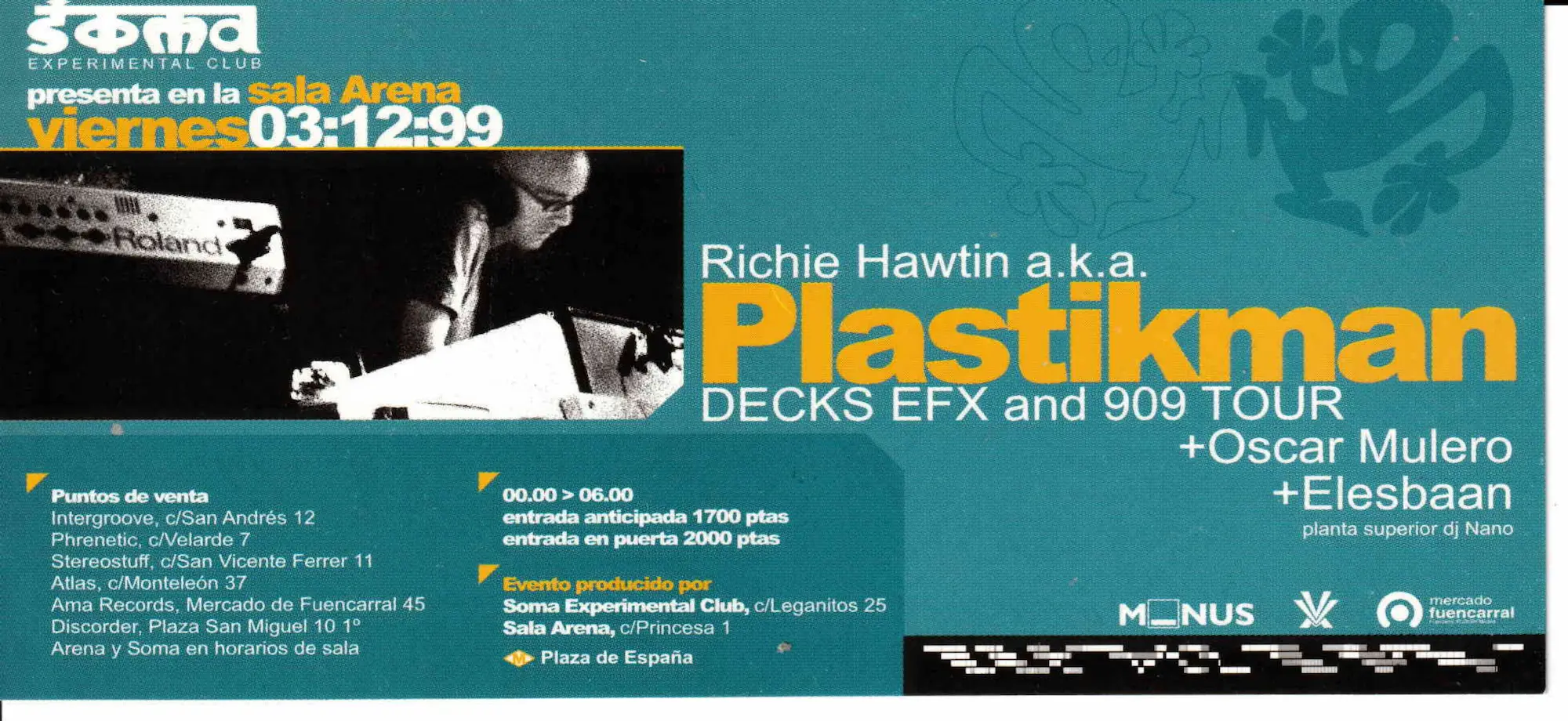
RICHIE HAWTIN A.K.A. PLASTIKMAN — DECKS, EFX & 909 TOUR
Sala Arena, Madrid · 3 December 1999 · Presented by Soma Experimental Club · Original flyer · Everybody Loves Archive
COCOON
Some of the names on these flyers look different now.
Time has turned them into references, discographies and histories.
But that is not how we experienced them.
On 19 July 2002, a Cocoon flyer announced Stacey Pullen — Black Flag Records, Detroit — alongside Pt.10 and Pepe Headturner.
C/ Amaniel 13.
01:00–06:00.
Entrance plus a drink: 12 euros.
Everything you needed to know was there.
The artist. The address. The time. The price.
There was no sense that you were looking at a historical document.
Back then, they were simply next Friday.
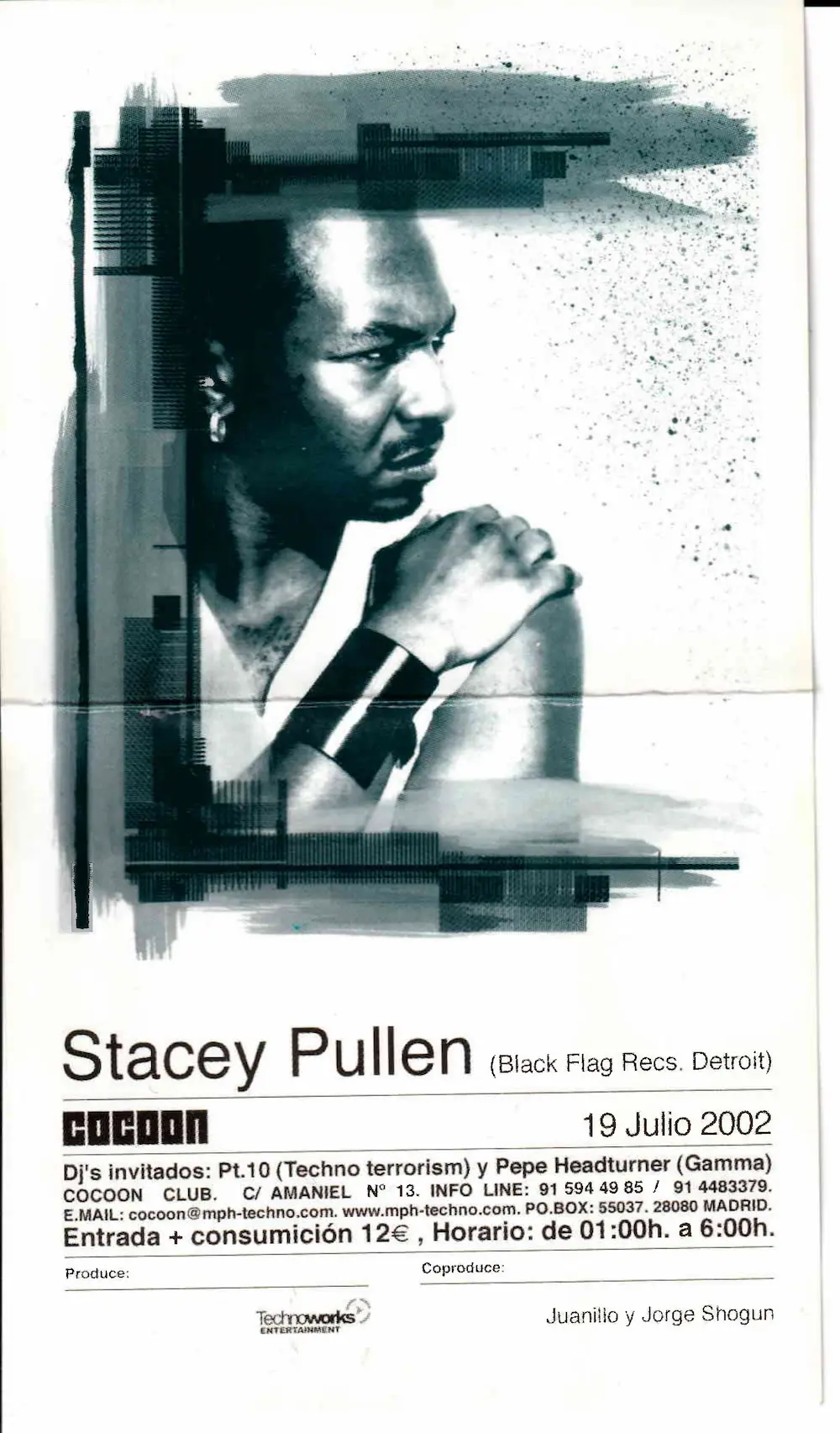
STACEY PULLEN — COCOON
Amaniel 13, Madrid · 19 July 2002 · Original flyer · Everybody Loves Archive
MONTEAGUDO 25
Not every night happened in a club.
Some took place in spaces that existed outside the usual circuits.
One of the flyers in the box comes from a techno party at an occupied building in Madrid.
I remember going to parties there.
But looking at the flyer now, what interests me is how little it explains at first.
There is no familiar club name.
No polished venue information.
Just another object that once circulated between people who knew enough to understand what it meant.
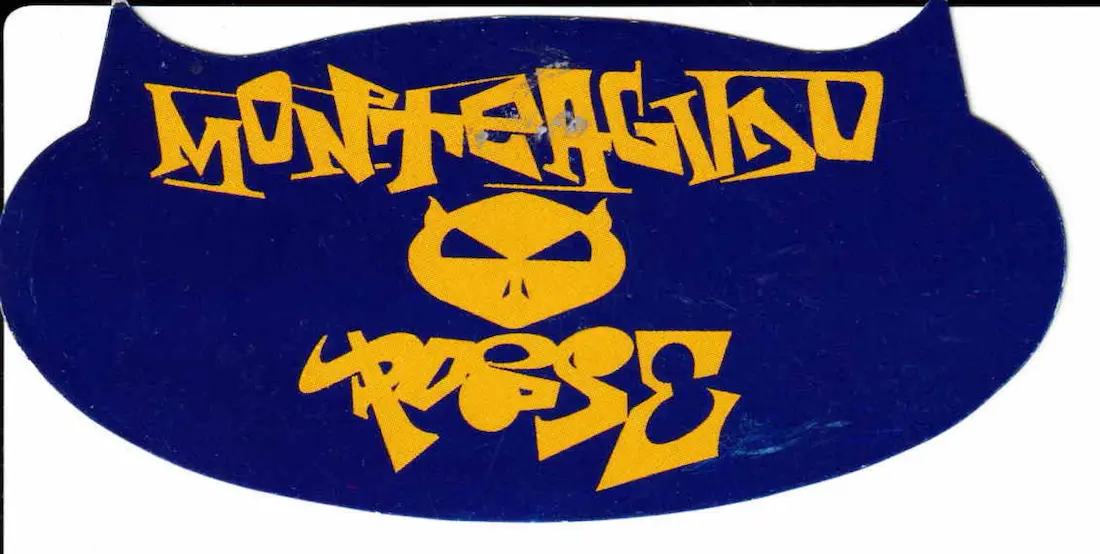
Turn it over, and the geography appears.
Marqués de Monteagudo 25. Madrid.
An address was enough.
The rest depended on knowing where you were going — or knowing someone who did.
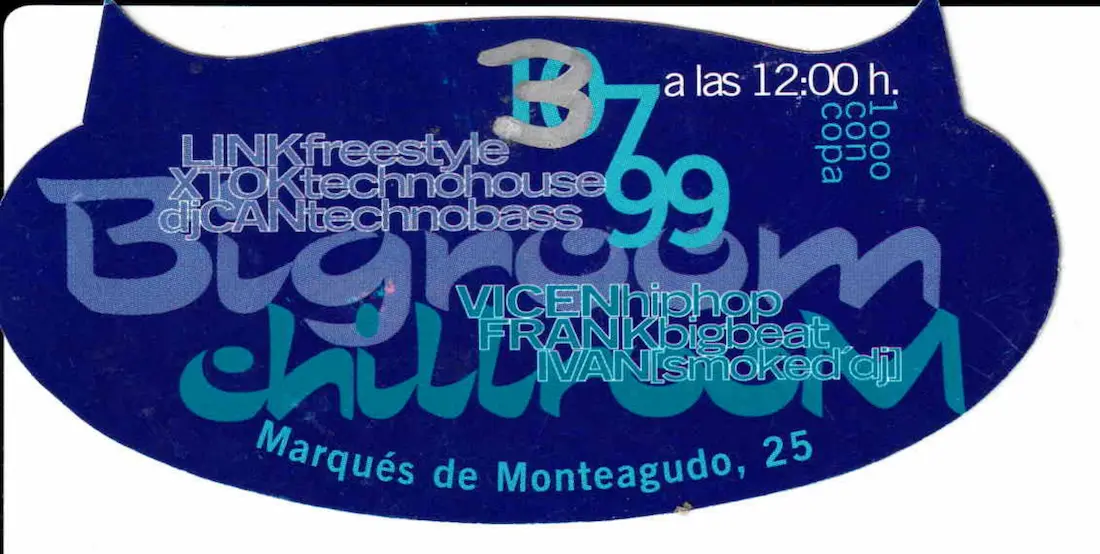
MONTEAGUDO 25 — TECHNO PARTY
Madrid · 1999 · Front and back of the same original flyer · Everybody Loves Archive
HOW TO FIND A RAVE
Some parties were even harder to find.
I remember going to Corto Maltés, a bar in Plaza del Dos de Mayo in Malasaña.
We talked to the bartender about a rave.
He handed us a photocopied map with directions.
That was it.
No link. No location pin. No event page.
We got in the car and followed the photocopy out of Madrid.
At some point, the road ended and we parked.
From there, we continued on foot.
There were candles marking the way through the darkness.
And then, somewhere in the distance, you could hear it.
Boom.
Boom.
Boom.
You followed the sound.
The photocopy was the map.
Word of mouth was the network.
The bartender was part of the distribution system.
And the kick drum was the final location pin.
WHAT DIDN’T SURVIVE
Not everything made it into the box.
There are nights I remember for which no flyer, ticket or piece of paper seems to have survived.
One of them was a rave at a place we knew as El Monasterio.
I remember the place.
I remember being there.
But there is nothing in the archive I can hold up and say: this is from that night.
And that absence matters too.
An archive is never a complete record of what happened.
It is simply what survived.
Some nights remain as objects.
Others survive only as memory.
A BOX, ALMOST THIRTY YEARS LATER
The box is still here.
A metal box, roughly the size of a shoebox.
Inside are hundreds of fragments from nights, clubs, concerts and places that once felt completely ordinary.
Most of them were never meant to last this long.
Flyers were folded and put into pockets.
Tickets were torn at the door.
Passes were used once.
Posters were pinned to walls.
They were temporary objects made for temporary moments.
And yet, somehow, they survived.
I started deliberately keeping these things around 1999, although some of the nights came earlier.
At the time, I wasn’t trying to preserve underground culture.
I was just keeping pieces of my life.
Only now, almost thirty years later, do they begin to look like an archive.
BEFORE THE ALGORITHM
This is not about saying that everything was better before.
It wasn’t.
Finding things was slower. Information disappeared. You missed nights because you simply didn’t know they were happening.
But that friction also meant something.
Culture didn’t arrive already organised in a feed.
You found it through people, places and objects.
A flyer passed from one hand to another.
A record led to a label.
A club led to another club.
An address led somewhere you had never been before.
Discovery required participation.
Before the algorithm, you had to find the culture.
EVERYBODY LOVES ARCHIVE
This box is only the beginning.
There are hundreds of objects still inside it.
Flyers, passes, tickets, credentials, posters and pieces of paper connected to clubs, concerts, parties and places that deserve to be looked at again.
Some will come with clear dates, names and addresses.
Others will require some digging.
And some may remain a mystery.
Everybody Loves Archive will be a continuing series built from those objects — one piece at a time.
Not to reconstruct a definitive history of nightlife or underground culture.
But to look at what survived, find out what we can, and remember what it felt like to discover culture before everything was searchable.
We didn’t know we were building an archive.
We were just going out.

Leave A Comment